
AI in B2B Marketing in 2027
A.I. overpromised and undelivered for B2B marketers in 2026. Here’s how to pivot to successful AI-enablement in 2027.


NEED TO KNOW
- AI in B2B marketing has many uses but is not an all-purpose tool
- The AI hype cycle is beyond the ‘Peak of Inflated Expectations’ phase
- An operator’s AI skillset is more important than his toolset
- Savvy B2B marketers are preparing for an AI-enabled pivot in 2027
- CXO expectations need to be reset when it comes to AI
The AI hype cycle is losing steam due primary new developments: fundamental realities about how business is conducted are proving true, and in the wake of unrealistic expectations. Conversations have moved from “AI is coming for 50% of all jobs” to “it seems that we underestimated how much we are going to be able to keep people at the center of everything“.
Early reports about AI’s abiltity to deliver ROI are uniformly unexceptional: a report by MIT showed that 95% of AI projects fail, and a National Bureau of Economic Research survey of 6,000 executives asserts “90% reported no measurable improvement in productivity attributable to AI across the last three years.”
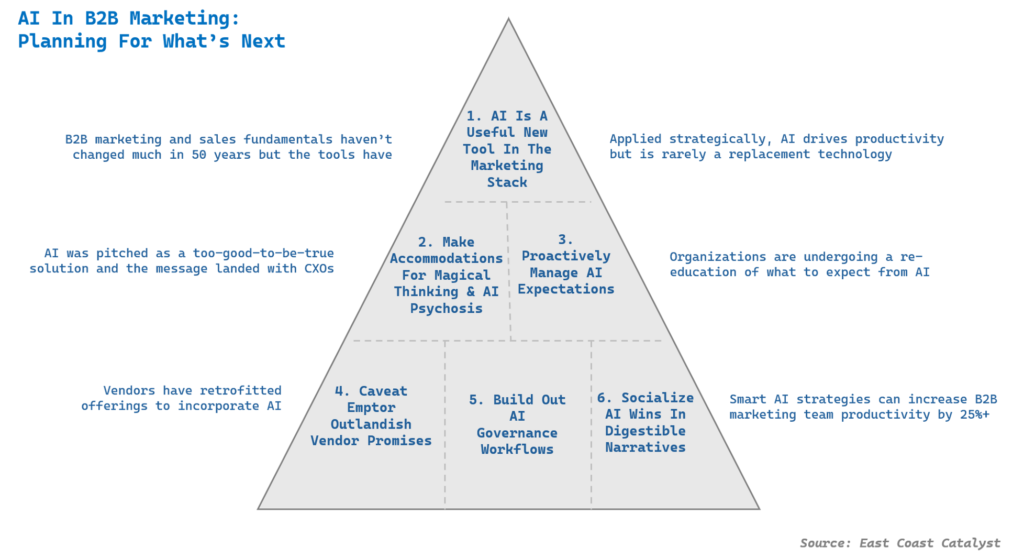
But with hundreds of billions of collective dollars invested, the AI show must go on, and we need to find a way to make it work. In this pursuit, some commercial sectors have been hit particularly hard by the AI frenzy, including software programming, entry-level administration and research roles, and marketing. For AI in B2B marketing in particular, the combination of trade wars, hot wars, and AI exuberance has taken its toll over the past couple of years. As we move into a new phase of adoption — AI is here to stay, there’s no debate — here are six considerations to help B2B CxOs navigate the AI terrain successfully in H2 2026 and beyond.
1. AI Is A Useful New Tool In The Martech Stack
In short order, AI has become a staple in the B2B marketer’s toolbox. Most marketers use AI regularly throughout the day — for ideation, fact-checking, competitor research, editing, analytical support, you name it. But AI is settling in more like a carpenter’s nailgun or chef’s microwave oven than a replacement tool like the word processor antiquating typewriters or automobiles supplanting horses-and-buggies.
The 2026 marketer needs to be AI-savvy. It’s no longer a nice-to-have but rather a cost-of-doing-business. That’s a certainty. At the same time, as the AI hype cycle smolders, core best practices are proving timeless: compelling creative, timely and targeted messaging, and — especially in B2B — regular in-person interactions continue to drive winning strategies. Beyond AI’s usefulness in the marketer’s toolbox, it is having a major effect on customer journeys, sometimes in ways that are almost invisible to the end user — such as how nearly half of consumers use AI-based search to guide purchase decisions (because Google is constantly using AI to sharpen results).
2. Acknowledge AI Psychosis & Magical Thinking
For whatever reason, the tech community is particularly susceptible to hype cycles (think: dotcom, internet of things, metaverse, cloud computing) and AI hit as hard as any in recent memory. But it also seems like the intensity of the surge led to a compression of the ‘Peak Of Inflated Expectations’ phase. It will take a few years of data collection to develop an accurate understanding. It will also take years for the early adopters and true believers to reset expectations, so best to be fully prepared for edge-case conversations. AI was served up by some of the most famous people in the world as the ultimate hack and insider trade. That it was so obviously too-good-to-be-true in all but the most extreme cases (ex: solving the Dinitz-Garg-Goemans conjecture) and in a couple of pockets of the economy may never be acknowledged or internalized,
One of the first to publicly discuss this condition was, of all people, the CEO of Box — a veritable tech bro and presumably at least moderately invested in a handful of hot AI startups. He said: “CEOs are uniquely prone to AI psychosis because they’re sufficiently distant from the last mile of work that still has to happen to generate the most value with AI. So when they play with AI, they see the happy path results, often not considering the next 10 or 20 things that have to happen to get sustainable results from agents.”
A close cousin of AI psychosis is magical thinking. Keep an eye out for both and plan accordingly.
3. Proactively Manage AI Expectations
For most marketers, AI is best thought of primarily as a productivity tool, not an innovation-enabler. Most marketing teams have been using AI for at least a couple of years now and would broadly agree to this.
Today, AI mainly shortens the duration of labor-intensive tasks and facilitates a certain type of collaboration previously unavailable when working autonomously. These are not trivial contributions. It means that some types of marketers (ex: writers, social media managers) can as much as double or even triple their output. Some might even characterize this as “force multiplication”.
That AI can be deployed as an innovation-enabler in some situations is an added benefit, though not a mainstream one. If a company wants innovation, AI is one of but many available tools to facilitate the evolution. More common tactics are channel diversification or M&A, for example.
With a complicated and noisy category like AI — which is getting propped up by billions of dollars in advertising — everyone is going to come to planning sessions with their own unique set of assumptions. Get out ahead of this challenge with a quick, individual survey before the meeting that poses questions like “What is your favorite AI tool and how often do you use it?” and “What is the one area of marketing where you think we should absolutely be using AI?” The areas of common understanding will give you confident reference points to facilitate planning discussions.
4. Caveat Emptor Outlandish Vendor Promises
Elon Musk has been promising the coming of self-driving cars for more than a decade and today is the world’s wealthiest person. In some corners of the economy, the marketplace richly rewards brash and visionary claims, no matter unlikely to materialize. Vendors are gonna vendor.
But most industries are subject to fundamental — if not immutable — economic and operational principles and it’s important not to get caught up in the AI hype, because it could cost you your job.
If it sounds too good to be true, it probably is. If a product description is too complicated to easily understand, that’s a red flag. Everyone’s an AI company nowadays, some to an incredulous extent.
5. Build Out AI Governance Workflows
For AI-first marketing organizations and teams in highly regulated industries like healthcare and financial services, formalizing AI governance is non-optional. The technology is too new, too leaky, too unpredictable.
=======================================
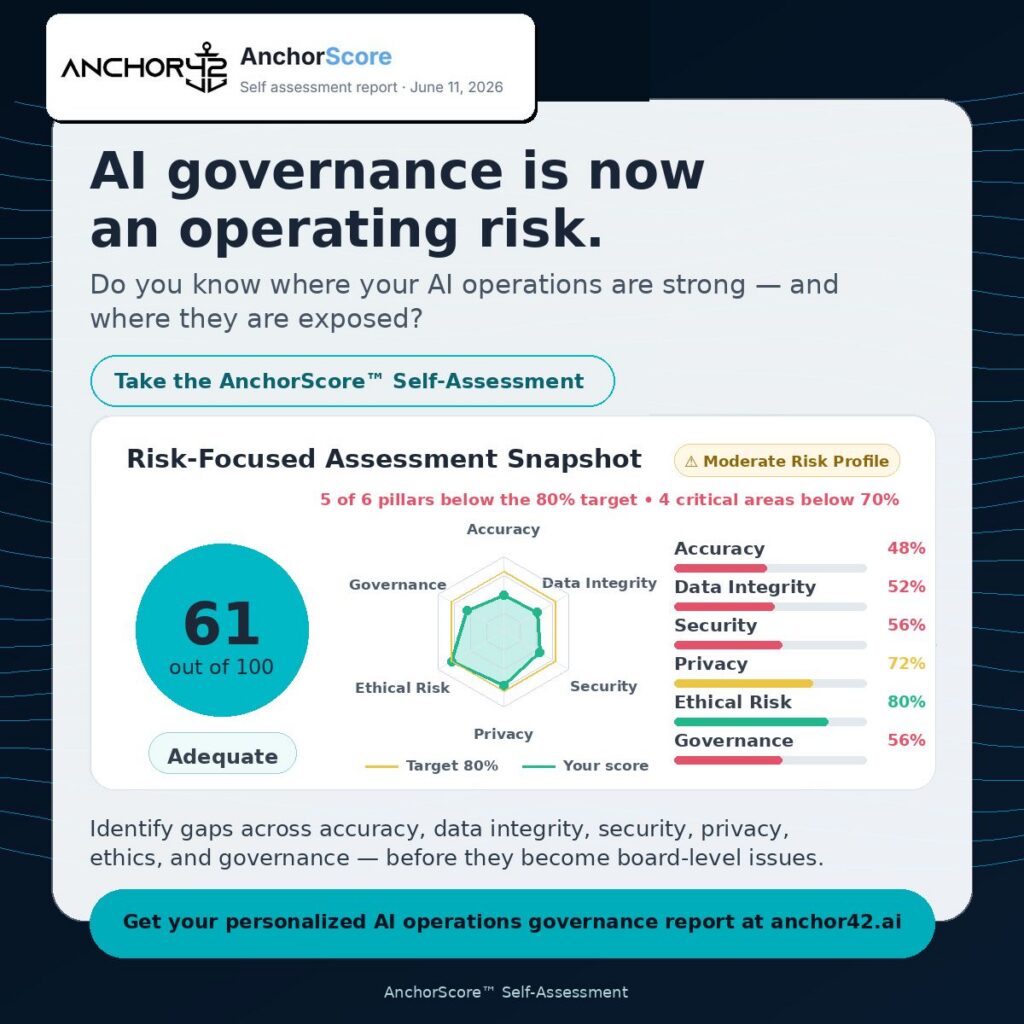
Editor’s note: get a free AI readinessment assessment from Anchor42 here
=======================================
But most SMB marketers can get away with using baseline data and asset management governance principles extended to AI: safeguard what you collect, don’t misuse it, and make it difficult to steal. (How the AI is configured and its access privileges are completely separate issues, of course.)
6. Socialize AI Wins In Digestible Narratives
AI wins in Big Tech look different from AI wins in financial services. Context is important.
Marketers are domain experts at promoting others and their wares but self-promotion often gets overlooked. When it comes to AI, everyone — from the CEO down — needs wins. The pressure is real: from investors, customers, partners, you name it. Internal communications teams are well-served to be proactively on the lookout for AI wins — anywhere in the organization — and find effective ways to promote them.
RESOURCES & FURTHER READING
- B2B Digital Marketing Case Studies
- B2B Paid Media Strategy Guide
- What Is Conquesting?
- Google Big Winner In AI Arms Race
- Marketing Audit Services
############################################
Tim Bourgeois is a B2B new business development consultant at East Coast Catalyst. Contact him at tbourgeois(a) eastcoastcatalyst(dotcom).