
Google Big Winner In A.I. Arms Race
Google cemented its leadership role in the AI arena in 2026 and is now the unofficial gatekeeper of the open web.


NEED TO KNOW
- Google successfully navigated the A.I. rush in 2025-26
- The company’s value has increased 60%+ since 2024
- Google controls ~25% of all internet traffic
- Generating organic traction on the open web is difficult
- Google Ads is more important than ever to B2Bs
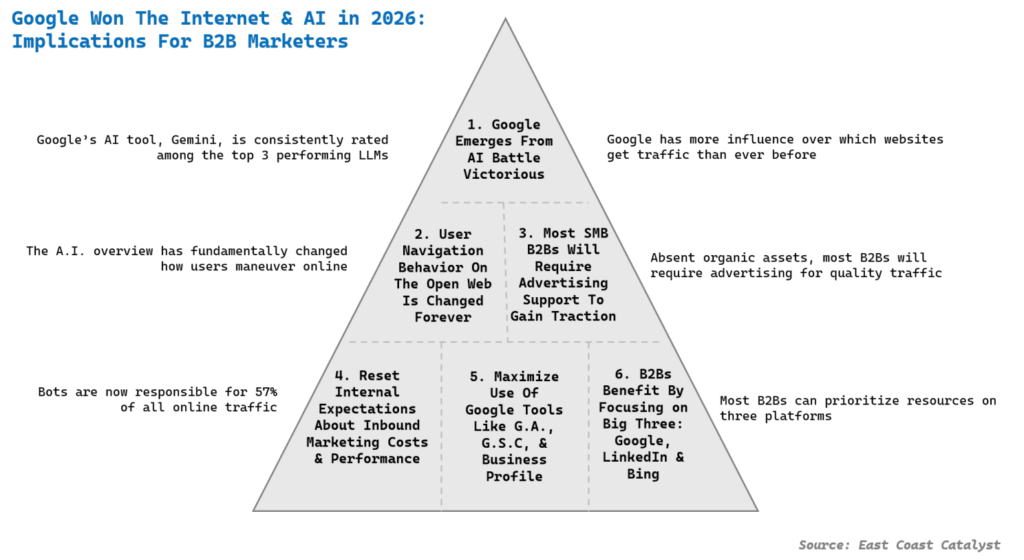
1. Google Emerges From A.I. Onslaught Stronger Than Ever
With more than 50% of all online traffic now generated by bots and A.I., the internet has never been more noisy or complicated to navigate than it is today, and Google is in the driver’s seat to influence enormous swaths of traffic for years to come. This wasn’t a foregone conclusion in early 2025, when a slew of deep-pocketed companies from IBM and Microsoft to SpaceX and Meta were competing in the A.I. arms race for supremacy. Fast forward 18 months and along with OpenAI’s ChatGPT and Anthropic’s Claude, Google Gemini is now widely recognized as a top three LLM (large language model).
Investors have noticed. The stock price has soared and outperformed direct competitors like Amazon and Meta by 2X. Perhaps most convincing: Berkshire Hathaway recently increased its stake in the company — on Warren Buffet’s recommendation — and Google is now one of its top 10 portfolio holdings. The company joins stalwarts like American Express, Coca-Cola and Chevron — decades-old companies that are embedded in the daily habits of global commerce.
Implications For B2B Marketers: For companies that rely on inbound marketing programs that are dependent on meaningful volumes of quality web traffic — which is to say, most companies — Google Ads are now effectively mandatory for scaling and predictable lead flow.
2. User Navigation On The ‘Open Web’ Is Forever Changed
I first noticed the grumblings getting louder about a year ago, mostly from heavy information consumers like reporters and researchers. The general sentiment: “Google is starting to suck”.
And then this month a writer from the influential The Ringer analyzed the situation correctly and in more detail: “For years now, Google has been tweaking its search formula to prop up AI and bury actual links. Now it’s rounding into its final form—and changing the internet forever.”
The grip-tightening was inevitable. Bills from years of ZIRP-fueled investing and free technology were eventually going to come due, and the A.I. frenzy created conditions for the next evolution of the web to occur — like how medical and technology advancements often happen in wake of disruptive human events like wars (see: organ transplants, drones).
The internet landscape is evolving in some ways to resemble the retail industry. Behemoth retailers Walmart, Amazon and Costco combine to move more than $1 trillion worth of goods each year in the U.S. and account for ~15% of all spending. When it comes to U.S. ecommerce, those same three companies combine for more than 50% market share and as a result have enormous influence over macro retail trends and winning and losing products. The internet of the future is headed in a similar direction. The open web isn’t dead, but a handful of large companies, including Google, have consolidated power and installed more toll booths on the information superhighway. Consequently, pay-for-play is becoming the path of least resistance for many brands.
Implications For B2B Marketers: The open web is dead; long live the open web. For most B2B marketers at small- and mid-sized businesses, advertising tactics will likely be necessary to grow consistently, in part because scaling organically is too dependent on finicky algorithm updates. Best practice companies will aggressively incorporate both paid and organic tactics to maximum performance.
3. The Halo Effect Is Real & Quantifiable
I have long theorized that paid media is more effective than what the data tells us — that it effectively punches above its weight class. This POV is partially a takeaway from managing dozens of client programs over the years but also due to the increasing noise-to-signal ratio online, which makes it extraordinarily difficult to track activity precisely and with a high degree of confidence.
Consider the environment: only about 4-of-10 web users are human; AI makes it easier than ever to pump out content slop and make traffic insights more challenging to decipher; and the industry’s most-used analytics platform (Google Analytics), run by 70% of the companies around the world, is a free tool made available to mine online behavior and sell ad products. So a big chunk of the internet ecosystem is a mass of bots and slop and the primary monitoring tool is a black box provided with no support from the category’s biggest vendor. So being suspicious about analytics quality isn’t conspiratorial, it’s common sense and Q.E.D.
More specific to paid media performance, Google Analytics breaks out activity into unique channels to describe how traffic arrived: directly (e.g., an email link), from a search engine like Google or Bing, from a referring site like NYTimes.com or WSJ.com, or from advertising. This data is useful for myriad reasons, but is also an ongoing challenge because anywhere between 30% and 70% of users deploy privacy controls to make themselves virtually invisible online, or at least difficult to track precisely.
So I was interested to see what would happen in late 2025 when a client decided to hit pause on its digital advertising.
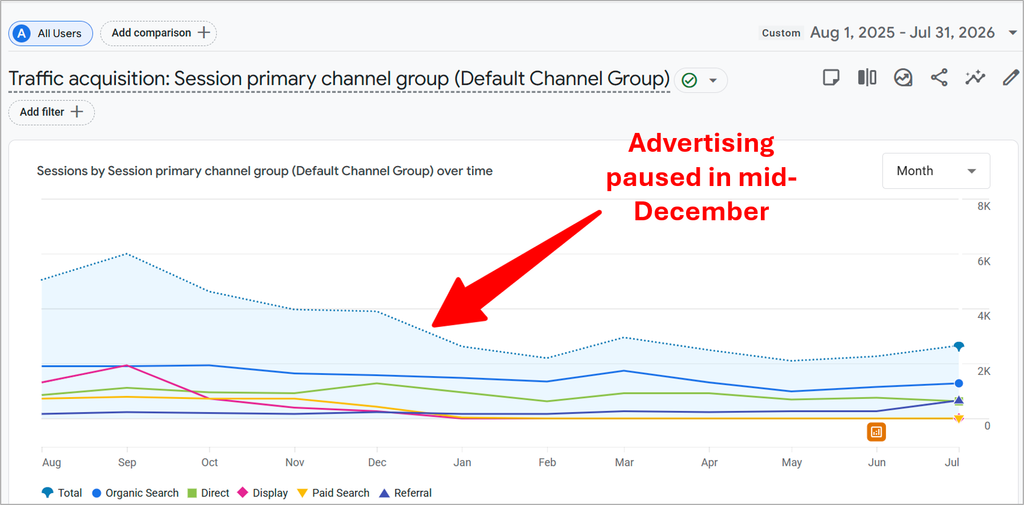
During Q4 2025, paid activities accounted for 35% of all website traffic — about 5,500 out of 15,000 total visitors, or 1,800 / 5,000 monthly. During H1 2026, overall site traffic decreased not by 35% but by 50%+ — from 5,000/month to 2,450, a not-insignificant spread of 15%, when nothing materially changed other than turning off advertising.
The number of engaged visitors — users that spend more than 10 seconds on the site or click 2 or more times — decreased by ~600/month. For a B2B, 600 fewer shoppers per month translates to about 30 fewer leads per quarter, which can mean the difference between hitting quota or not.
Occam’s Razor suggests the takeaway here is that Google customers — i.e., buyers of ad products — get preferential treatment across the board by the company, and that makes sense to me, for at least two reasons:
1. Google has more and presumably better information about its customers than non-customers and is more confident driving traffic to those web properties
2. Like everyone else, Google has trouble figuring out precisely how traffic moves around the internet and out of an abundance of caution (and risk management) misses a sizable portion of ad traffic and registers it in other out-of-the-box channels like “direct” or “referral” instead
The underlying cause of the impact isn’t all that important, though. We see this pattern consistently across B2B customers and especially with early-stage organizations that are trying to break into competitive categories or establish new ones. Without a bone fide social media star on the payroll to fuel organic efforts, B2Bs struggle to move the digital needle in absence of advertising. And when they turn it off, the effects are more pernicious than expected.
Implications For B2B Marketers: Businesses — and especially large companies — are spending more on digital ads than ever before. Google’s search business will increase by at least 15% this year, expanding by $30 billion year/year, in an economic environment characterized by uncertainty and and where executives have been understandably skittish about making big bets. But the spending on internet ads continues because it’s such a proven and reliable tactic. (The same is true for LinkedIn Ads, which is growing at a similar rate.)
4. Resetting Internal Expectations On Cost & Performance
One of the biggest ongoing challenges for B2B marketers — especially VP level and above — is figuring out how to reset expectations among the C-suite about how advertising can contribute to growth and net new revenues. This audience has been getting bombarded with messaging from Big Tech for years about how doing internet things is easy and cheap, and this trend was in overdrive during the past 24 months of the AI surge. In practice, neither assumption is true anymore, at least in competitive industry categories.
The reality is that the internet today less open and more expensive than it was a year ago — i.e., it’s becoming more of a gated community than not — and advertising ROI models are evolving. In the 2010s, B2Bs could confidently forecast X number of low-funnel incoming leads and translate that into meaningful short-term “net new” revenues. Those assumptions have not held up over the past two years.
Today, low-funnel inbound leads are common but not as abundant, and so the economics have changed considerably. In the face of uncertain economic conditions and companies delaying new project spending, the ROI window has shifted from 6-12 months to a more realistic 18-48 months.
Implications For B2B Marketers: Digital marketing and advertising KPI benchmarks have shifted dramatically in recent years due to unpredictable macroeconomic conditions and an influx of large companies (and large budgets) into the digital ads ecosystem. Everything has gotten more expensive and less predictable. B2B marketing managers are well-served by communicating regularly up and across the organization with updates on market conditions (i.e., the healthy increase in ad spending across the board) that contribute to CxO education and helps to inform expectation-setting.
5. Use Every Tool Google Makes Available
Google is a technology juggernaut worth trillions of dollars and aggressively and continuously works to advance its competitive advantages through whatever means possible, including sharing the least amount of information the law will allow about its business practices — just like Amazon, Meta and others do.
What Google does provide, however, in unambiguous ways, is a roadmap for how to appeal to its algorithm and offers up a handful of free tools to help with the effort. These are: Google Analytics, Google Search Console, Google Tag Manager, and Google Ads. Organizations that aren’t actively using most or all of these tools to understand what, how and why traffic is moving — or not — to their websites have gaping digital blindspots. Accommodating Google is a top priority for most B2B marketers and the tools they provide are table stakes for making it happen.
Implications For B2B Marketers: Audience definition and understanding is vital for marketers of every type, B2B or B2C. Embracing the concept of “audience of one” — in this case, Google — is a big leap but is a requirement for most B2B organizations. Make Google happy and you’ll get more quality website traffic and new customers; it’s a straightforward objective that is complicated to execute.
6. Keep Focused On ‘The Big Three’
When it comes to B2B digital marketing and influencing internet traffic, Google is the biggest player and it’s not close. The platform processes ~200X the volume of inquiries as compared to LLMs on a daily basis, for example.
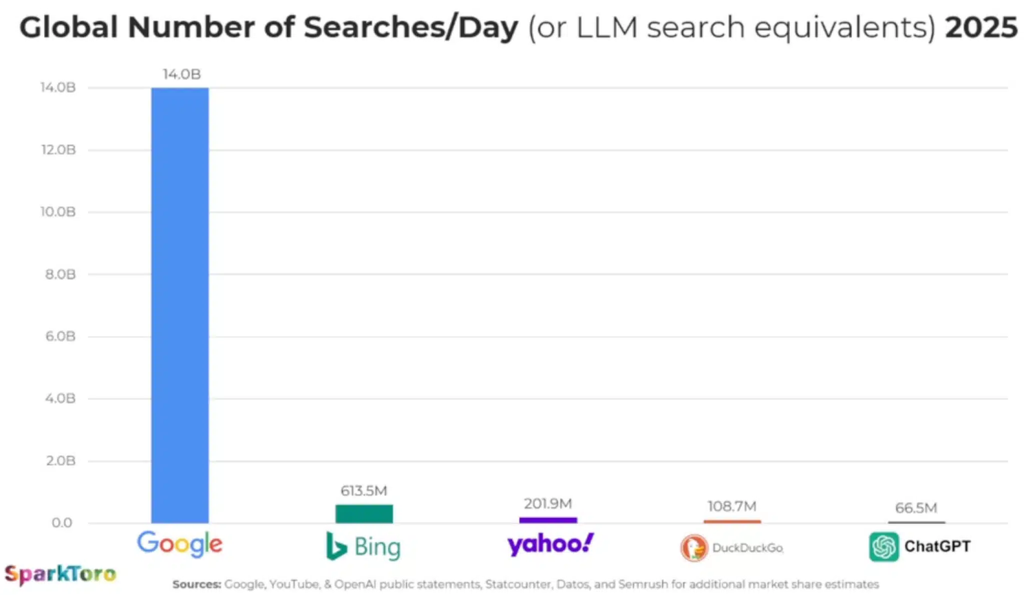
Google’s 90%+ market share is why it commands so much attention from B2B marketers. But it’s not the only game in town, and two platforms have evolved significantly in recent years and both are owned by Microsoft: LinkedIn and Bing.
LinkedIn is a walled garden with 300 million monthly users and has emerged as a reliable channel for messaging to hard-to-reach senior executives. Bing is a distant second to Google in search volume but still processes half-a-billion search inquiries every day and is natively integrated across the Microsoft product suite — so users are sometimes relying on the Bing search engine without even knowing it.
Implications For B2B Marketers: It’s Google’s world and B2B marketers need to find ways to succeed in it but LinkedIn and Bing are worthy of attention and resources, especially as as Google continues to tighten its grip on the internet ecosystem writ large.
RESOURCES & FURTHER READING
- B2B Digital Marketing Case Studies
- B2B Paid Media Strategy Guide
- What Is Conquesting?
- Does PPC Work For B2B?
- Marketing Audit Services
############################################
Tim Bourgeois is a B2B new business development consultant at East Coast Catalyst. Contact him at tbourgeois(a) eastcoastcatalyst(dotcom).