
B2B Marketing KPI Best Practices
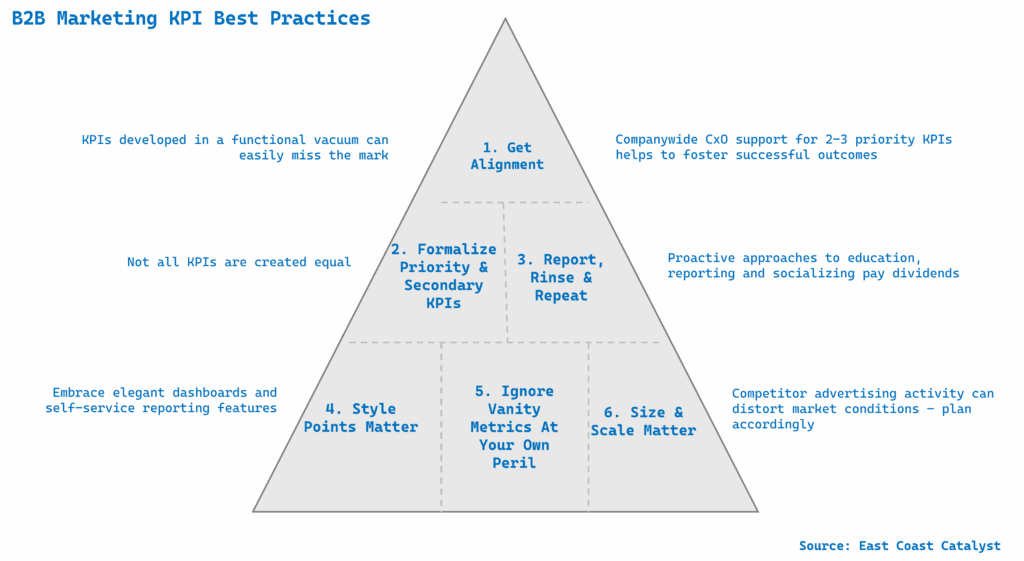
Six priorities for B2B managers to keep top of mind when thinking about KPIs.


NEED TO KNOW
- Get CxO alignment on KPIs
- Formally define priority and secondary KPIs
- Report on KPI performance regularly
- Deploy shiny, interactive dashboards
- Don’t ignore vanity metrics
- Adjust tactics based on competitors’ size & scale
2025 hasn’t been a great time to be a B2B executive. A recent McKinsey report summarized conditions smartly: “Trade norms are in flux, monetary policies are shifting, and geopolitical developments are impacting global business practices. For B2B companies, the net result is many are under tremendous pressure to adapt and grow.”
Marketing operations typically get extra scrutiny during bumpy economic periods, and that’s been the case for most of 2025. CxOs are being extra diligent about where and how they make investments, and KPI monitoring play a big role in justifying expenditures. Here are six priorities for B2B managers to consider when designing the KPI tracking plans.
1. Get Alignment
If you don’t know where you’re going, any road will get you there. Job number one in the marketing planning process is to get core objectives aligned with — and approved by — the CEO, CRO, and CFO. If it’s a technology company, include the engineering team as well.
This process can be involved and take awhile, even though the topics might seem fairly straightforward:
- What is the unique selling proposition (USP) for the product?
- Who is the ideal customer profile (ISP), including company type and executive title(s)?
- What is the competitive environment like and how much are they spending on advertising?
- How should the marketing team prioritize audiences across the customer journey funnel (top, middle, low)?
Pro Tip: Use 1:1 meetings with CxOs to tease out answers and thoughts to questions such as “who is the company’s most important audience and why?”
2. Formalize Priority & Secondary KPIs
As is the case with getting marketing strategies aligned with CxO expectations, formalizing and prioritizing key performance indicators (KPIs) is often more difficult in practice than in theory. Broadly speaking, this is a straightforward task in a B2C environment: a website visitor either buys something or does not. In B2B, however, where customer journeys take months or even years and the purchasing process involves committees with as many as a dozen members, the KPI setup and tracking process is more complex.
That’s why savvy strategy teams use easily understood models such as a funnel-like construct to frame planning discussions and get to consensus decision making. In this example, the funnel has three main areas:
- Top Introduction to topic and its implications
> “What is A.I. and how does it affect my business?” - Middle Problem solving and solution searching
> “What types of solutions can help me with A.I.?” - Bottom Solution evaluation and selection
> “Which A.I. companies should I talk to?”
Each phase of the B2B funnel is characterized by fairly common tools and tactics that the industry deploys and which are sometimes referred to as “lead magnets“. These include anything that gets a prospect’s attention, favorably positions a vendor vis-a-vis the problem/challenge, and advances the prospect through the customer journey.
- Top Learn more from explainer content on website or social media
like blog posts and videos. KPIs = traffic, engagement time. - Middle Download assets like white papers, checklists, or free
trials from the resource or register for a webinar. KPIs =
number of downloads and registrations. - Bottom Schedule a meeting for a demo or comprehensive introduction
in advance of a formal pitch. KPIs = meetings booked.
Pro Tip: Keep the operation oriented around priority B2B KPIs like cost per qualified lead and lead volume, and cost per engaged website visitor and visitor volume. More engaged website visitors lead to more quality inbound leads. Secondary KPIs will depend on the unique organizational requirements but will likely include metrics like internal mailing list size, total social media followers, and video views.
3. Report. Rinse & Repeat.
Reporting on B2B marketing activities and investments is almost as important as the performance itself. And sometimes equally challenging.
No two companies have the same reporting needs, so standardization isn’t a realistic option, although there is about 75% overlap across B2B companies when it comes to tracking metrics. But these metrics can have dramatically different roles in understanding impact. A company that sells widgets for $50,000 with a 45% gross margin has a unique business structure from a SaaS that sells $50,000 per month software subscriptions with an 80% gross margin and customers that stay for five years.
The basics in nailing B2B marketing reporting is three-legged stool: 1) templatized packaging, 2) realistic cadence, and 3) actionable insights.
The reporting template will require a few cycles to get into final format but input gathered along the way will help in cementing the template’s appeal. Creating unique reports every month and quarter is a heavy lift and requires a fulltime analyst on staff to make happen, which many SMBs aren’t able to staff, so templates are must-haves for small shops.
Adequate reporting cadence for most SMBs is monthly and quarterly, probably delivered in PDF form to a Slack channel and/or via email. Some companies might require every two weeks and that’s doable but weekly reporting for most B2B shops will raise more questions than provide answers because of the inherent volatility. For example, inbound lead volume for a typical SMB might average five per week but deliver 15 one week and three the next.
Insights are the brass tacks of reporting because they crystallize what’s working effectively and what needs to be tuned, and it’s an opportunity to highlight wins and explain upcoming tactical adjustments, like identifying more leads from a particular geographic region and adjusting budgets to allocate more dollars there.
Lastly, there are also audience types to consider when creating reporting strategies, and they generally organize into one of three categories at B2Bs: CxOs, companywide, and fellow marketers. The companywide audience only need high level performance metrics while CxOs require ROI-centric analysis and other marketers will want to understand under-the-hood statistics like channel-specific performance (example: Google Ads vs Bing Ads vs LinkedIn ads).
Pro Tip: It’s appropriate for the companywide monthly and quarterly updates to have an annual report-type of look and feel, as opposed to dashboards which are typically more gamified and flashy.
4. Style Points Matter
The emergence of data visualization vendors like Tableau and Qlik during the early 2000s changed the way managers deliver data to constituencies across the enterprise, whether it be in marketing, accounting, or supply chain management. Today, senior managers expect to have access to flashy, interactive dashboards that allow them to check in on performance 24/7/365. And it’s the job of the marketing manager to structure these dashboards in a way that are both useful to core audiences but also easy to maintain.
By definition, dashboards offer users self-service features and the ability to slice-and-dice data according to different time periods, channels, and geographies. This helps to foster an environment of transparency and inclusivity.
Pro Tip: Don’t underestimate what’s required to maintain dashboard data integrity. It requires both cross functional process diligence — which is never easy — and also at least a ½ FTE at a company spending more than $1M/year on marketing activities.
5. Ignore Vanity Metrics At Your Own Peril
B2B marketing vanity metrics like lofty numbers of social media followers or website pageviews aren’t critical to lead generation or brand building in the technical sense, but are very much required for the overall health of the marketing operation. Impressive vanity metrics are good for morale, make positive contributions in all kinds of difficult-to-attribute ways, and soften the ground for complementary tactics like SEO, PPC, and email marketing. More followers and website visitors is almost always a good thing.
A volatile environment where marketers are being asked to prioritize lead generation over just about everything else puts managers in a tough spot when asked to allocate scarce resources for vanity metric-style initiatives. There’s no getting around this reality, but it’s worth the effort to find solutions. Deploying creative ways to encourage participation and expand the company digital footprint in the process attends to various short-term needs and will pay long term dividends.
Pro Tip: Take advantage of every available hack using B2B growth marketing hacks and tactics before allocating any of the media budget to these efforts. Media will work, but will be relatively expensive.
6. Size & Scale Matter
Canvassing the competitive landscape prior to committing to any KPI targets is an obvious but commonly overlooked exercise. Start by gathering the category leaders’ advertising budgets, full-time marketing staff, and digital footprints. An early stage company with a lean operating budget that’s trying to disrupt a sector with deep-pocketed and savvy marketers isn’t going to be able to compete head-on.
There are plenty of ways for niche players to compete with behemoths, but the strategies must be selective, either by geography or audience type. In the tech sector — think Microsoft, Oracle, Intuit — many large companies spend more than $10M annually on digital advertising and have thousands of employees to help distribute their messages. These organizations can be challenged in very specific environments but are formidable at the corporate level, and it’s the same for leaders in any mature industry sector.
Pro Tip: Large companies can use relatively modest ad budgets to dominate awareness, drown out competitors, and disrupt customer journeys. Develop a keen understanding of the competitive landscape before committing to aggressive KPI targets.