


Every client we work with has asked us the same question for 2026 strategic planning: “How will we use AI to generate leads?”
We were tasked with it so often that we had to come up with an approach to answer it. In this post, I am going to outline our approach, offer up our insights from 2025, and give you our best recommendations for developing a lead generation strategy that will matter in 2026.
So at a high level, here are a few of the questions we started with:
- What lead generation strategies worked in the past year?
- Which trends that started during Covid actually stuck?
- What very obviously failed, and why?
- What do the platforms ask us to do in order to win?
Q4 is my favorite time of year, and I lovingly call it Strategy Season. Most businesses plan for budgets, strategies, and start making moves toward more positive change. We operate across dozens of B2B marketing environments, which means we see patterns early, and we optimize our frameworks accordingly.
Let’s start with what the data actually showed.
What Worked in 2025: The Lead Generation Strategies That Delivered Results
The behavior of a buyer has changed over time, and we see that 97% of buyers will familiarize themselves with a vendor via their website before any engagement. Therefore, your website is crucial in building trust early in order to even capture that lead’s interest and information. Despite that overreliance on independent research, only 9% of buyers actually trust what they read on a vendor website.
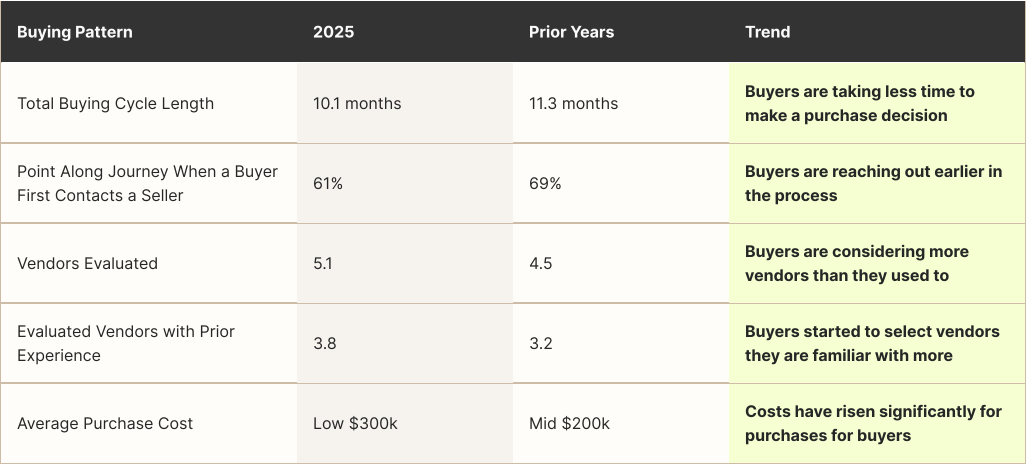
So we paid attention to how we could better build trust through the content on our clients’ websites.
Social Proof Everywhere
Social proof is a psychological theory that people copy actions of others in uncertain situations. For digital marketers, we leverage this theory through various means.
- Testimonials and reviews: Building rapport over time is a challenge for any business, but getting a solid testimonial from a client very clearly builds trust for all stages of your funnel. From a content perspective, testimonials are the heaviest hitters when it comes to improving our conversion rates.
- Case studies: Whether you have a high-touch sales process or a self-service model, being able to quickly tell a story about a success with your current customers goes a long way in educating your lead base. Case studies matter because
- Endorsements: This expands to all the small, subtle ways we build trust. We leverage “trust bars” on certain pages that show a collage of client logos (it is a part of our design system). This is also where we see success in influencer marketing.
- User-generated content: This one can be tricky, but having reviews on third-party sites like G2, Google, Facebook, and many others will often build a stronger trust signal for the brand, and we see that it improves conversion rates over time. We incorporate engagements on channels like Reddit to increase brand awareness.
Buyers trust people more than pages, especially with the oversaturated environment of unverified AI content. This is why we encourage creating lead generation strategy templates that include case study publishing as a formal step in the lead generation process. On Atlantic-powered sites, proof is built into the content model, making it easier to repeat, distribute, and measure its effectiveness.
Personalization That Felt Like Precision, and Not Creepy
2025 was the year we re-learned the truth: personalization only works when it’s grounded in real, structured audience understanding, not machine-generated assumptions. We spent a lot of our time this year developing an ICP and Persona-based research process that helped us fuel our content strategy. Personalization was built into this effort, and the outcome speaks for itself.
High-performing content teams leaned into:
- Persona-specific landing pages
- Industry-specific proof elements
- Segmented email flows
- Personalized onboarding and demo experiences
- Behavior-triggered nurturing
- Pre-qualifying PPC campaigns
Our strategy wasn’t to over-collect personal data, it was to fine-tune our timing, messaging, and relevance at scale. We did this using modular, persona-aware content structures throughout our clients’ websites that helped to create a lean buyer journey that cuts to the chase.
ICP Clarity: Accuracy Over Volume for Ideal Client Profiles
The best-performing content for generating leads were grounded in an ICP (Ideal Client Profile) approach, and we would align just about everything to that.
- Keyword Research: For every keyword that was relevant to our client’s business, we would map them to the ICPs we had developed, and categorize them based on funnel position and need.
- Homepage messaging: Of all the pain points, which ones are shared across personas? What resonates for the entire ICP?
- Paid media targeting: How do ads look for each persona within the ICP?
- ABM Lists: We will cover ABM further in this post, but steps were taken to evaluate each potential lead and map them to our structured ICP marketing.
- Persona-based content pillars: How is the content of the website structured and organized to streamline the education journey for each unique persona?
The paradigm shift in thought for our clients was to understand that each persona didn’t want more content, they wanted the right content. As an organization, that often means you are writing more, but not for the sake of volume; instead, it is for the sake of filling in specific gaps of knowledge per persona, and that can add up.
We used Atlantic, which is a content management system (CMS) that gave us a way to distribute taxonomy-driven content (think blogs, resources, events, etc.), ensuring fast journey-building and a quicker GTM-strategy.
ABM That Was Executed (Not Just Discussed)
The highest ROI in 2025 came from tightly run ABM playbooks. In the past, there were several attempts at getting our process right, and this often required a fair amount of improvisation. We could all agree that 2025 had a ton of technological and regulatory whiplash, so flexibility proved to be our strongest skill. But we shifted our ABM approach to be more of an orchestration, ready for flexibility, but strong in its framework.
[Insert a graphic of a table here, our branding. Source material.]
The average decision-making group of an enterprise has at least 10-11 stakeholders. Does that not warrant its own campaign?
The best ABM strategy usually includes:
- A named list of target accounts, straight from leadership
- Personalized microsites and landing pages for each account
- A dedicated, multi-disciplined team that delegate tasks
- Deal-stage content
- Traditional and digital marketing strategies that coincide
ABM tools and campaigns can be complex and expensive, but you can do some ABM with smaller teams and budgets. If you want to test ABM in 2026, consider a mentality of “many-to-one” rather than “one-to-many”. Aim for less targeted accounts with more quality campaigns, rather than 10,000 accounts all sharing one or two poorly executed campaigns.
Relationship-Led Marketing Outperforms Every Channel
After Covid, many predicted the decline of in-person relationships in business. But the opposite has happened since 2024, with increases in both outcomes and demand for in-person engagement.
Top performers doubled-down on live events, workshops and webinars, partner co-marketing, community-based thought leadership, and authentic sales follow-ups.
Platforms rewarded this, too. Social networks pushed native content and conversations. Email platforms prioritized sender reputation, not automation volume. Google rewarded expertise and first-party data. YouTube has taken a stand on AI-generated content and added more AI governance around how it is used and monetized on its platform.
Relationships aren’t a channel, they are a multiplier. Digital channels should work to strengthen relationships.
What Didn’t Work in 2025
Here’s the uncomfortable and necessary truth: None of the standalone AI tools produced meaningful ROI in 2025. We tried several things:
- AI email generation: Your customers are smart and they can sniff out fake-sounding copy.
- AI blogwriters: We shifted toward using it as a pre-writing tool, and refuse to copy/paste.
- AI sales assistants: People are way better than bots at this right now.
- AI lead scoring: The scoring is only as good as your leadership’s understanding of the score, how specific you can get, and how repeatable and predictable your web users can be. It’s only as good as the metrics you follow.
- AI chatbots: We have seen some success here, but only if you have a lot of useful content and clear guidance.
Usually, many of these failures were due to launching the tools on broken systems. We much prefer to build websites on a scalable, schema-based platform to increase the likelihood of success for agentic initiatives.
Our Predictions for Lead Generation in 2026
Based on performance, two things have emerged as our guidepost for 2026.
- There is no magic bullet for building relationships.
- Those who win will have the strongest digital ecosystem built for AI.
Let’s break that down.
A Relationship With A Lead Happens Well Before A Conversion
As an organization, you can use many tools that help to narrow the field to get closer-and-closer to a qualified lead. Some businesses start that journey with their audience at a very high level, while others position themselves within a very tight niche. Your exposure to your audience begins the relationship, whether or not you can measure that.
As your leads move through the funnel, and expose themselves to more of who you are, your channels and systems become more efficient in guiding that user toward becoming a lead.
By the time that person fills out a form, they are already well-aware of your solutions, your offering, and likely your values. Enough trust was built to compel them to reach out. Likely, they have read messages from a chatbot or automation that made them feel heard. But not enough that they could go without connecting with someone.
There is no way around that in 2026. People want to connect with people, and the more you focus on enabling that moment, the better outcomes you will see in your program.
Infrastructure Will Ensure AI Success
Do not lose sight of the fact that the “A” in “AI” stands for “Artificial”. It is still a machine that needs human intervention to function predictably. When an organization wants to launch AI in any given system, its success is contingent on how well structured the ecosystem is built.
We took the initiative to fully own that infrastructure for our clients by using Atlantic, a website and analytics platform that has clean tagging, KPI-level dashboards, schema-based taxonomy, and a lead-gen focused strategy. We are able to see strong analytics that help to improve layouts for designers, copy for writers, and buyer journeys for leaders.
A solid digital infrastructure is step 1 in launching a successful AI project in 2026.
The Bottom Line: How to Create a Lead Generation Strategy for 2026
If you want an effective lead generation strategy next year, here’s the distilled version:
- Start with ICP clarity
- Build persona-specific content pillars
- Focus on proof, not promises
- Consider using ABM for an aggressive B2B lead generation tactic
- Prioritize distribution channels that reward relationships
- Fix your analytics before touching AI
- Use AI inside a system, not as a substitute for one
AI will work in 2026, but only for organizations with discipline to build the system underneath it. Some agencies pull that together. We built a system from the ground up to empower our clients to launch AI initiatives with confidence.