
Is It Time For A Digital Marketing Audit?
Uncertain economic conditions and the introduction of AI has created challenges for B2B marketers. An audit can help.


NEED TO KNOW
- Unpredictable geopolitics wreaked havoc on the 2025 B2B climate
- Traditional B2B marketing KPIs didn’t hold up last year
- Spending by B2B advertisers has tripled since 2019
- AI tools are allowing marketers to do more with less
- Digital marketing audits have widespread appeal for benchmarking & planning
We have identified six key benefits assoiated with a digital marketing audit project in 2026.
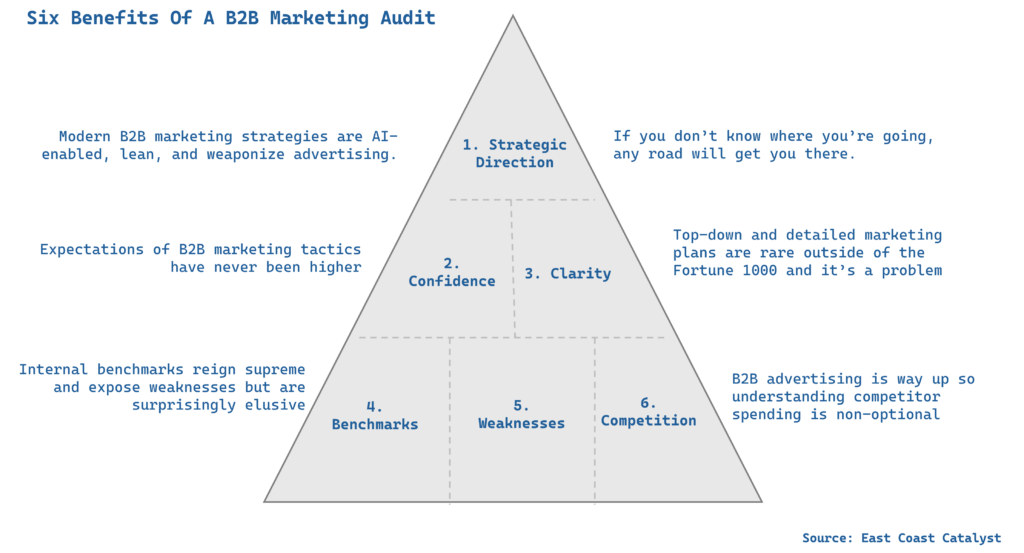
1. STRATEGIC DIRECTION
2025 saw the perfect storm of unpredictable economic conditions, the continued surge in B2B ad spending, and explosion of A.I. The net effect: fewer shoppers, more advertisers, and increased pressure on marketing teams to do more with less.
Planning is always challenging — “it’s tough to make predictions, especially about the future” — but is especially vexing in this kind of environment. Historical KPIs like inbound lead volume and sales velocity have lost meaning in absolute terms (maybe temporarily, maybe not) but the general direction is probably correct: B2B digital marketing remains highly effective, but everything is more expensive and takes longer now. The cat is out of the bag, so to speak, when it comes to digital marketing and B2B success. It can be a source of competitive advantage but it’s also baseline table stakes to compete in a category.
The implications of this new environment are significant and adjusting CxO expectations downwards is hazardous work. An audit can help to initiate the discussion in a structured way, based on performance statistics and analysis, so decisions are data-driven. And the flipside of an audit is the recommendations and roadmap deliverable, which serves as a useful guide for pivoting or evolving the B2B marketing shop.
Takeaway: Tried-and-true tactics for many B2B marketers were upended in 2025; teams need to purposefully and aggressively evolve to maintain relevance in 2026 and beyond.
2. CONFIDENCE
The triple witching effect of a weak B2B buyer market + AI + increased competition makes it almost impossible to identify the real underlying forces at work over the past year. This kind of an environment sparks difficult conversations.
- What do the baseline KPIs tell us — traffic, leads, meetings?
- Are marketing trends aligned with sales trends?
- Have our campaigns simply run their course?
- Did we make any unforced errors?
- How aggressive are our competitors behaving? Strategic-minded organizations often invest aggressively in soft economies.
Making difficult decisions in the face of these kinds of open questions — and with data that isn’t always bulletproof — is a challenge. In this environment, B2B marketers can seek safe terrain by aligning with big, safe brands like Google and Microsoft. Following its $4 billion investment by Warren Buffet in Q4 2025, Google has never been a safer play, now residing alongside other Berkshire Hathaway infrastructure-style portfolio companies like Bank of America, Chevron, and Coca-Cola. The same principle holds for Microsoft properties LinkedIn and Bing: not going to get you fired. This is especially true for LinkedIn, which has effectively gone corporate mainstream in recent years.
Our Take.The B2B marketing ecosystem evolved from adolescence to adulthood in 2025 and began correcting in earnest to accommodate a non-ZIRP environment; prices increased meaningfully across the board to reflect the ROI associated with selling big ticket B2B solutions. Data-driven confidence will be elusive during this transitionary period.
3. CLARITY
Consistent and reliable performance reporting is an ongoing battle for digital marketers of all types. Sketchy data, spiky data, broken integrations, evolving definitions and finicky platforms make performance clarity something of a unicorn.
That’s why topnotch B2B marketers like Qlik, ServiceNow and Stripe have a dozen or more professionals on staff with words like “marketing analyst” or “performance insights” in their titles. Everyone is working towards more finely tuning their understanding of customer journeys and attribution and how all of the different knobs and levers work together. The general market assumes much of this can be automated, but the best B2B brands seem to be increasing their investments equally across tools and analysts.
Audits can help teams discuss blind spots and problem areas in a problem-solving, continuous improvement kind of environment. Though audits are sometimes indeed combative and result in wholesale organizational changes, they don’t have to be. Performed regularly — say, every 24-36 months with quarterly check-ins — they become a fabric of the operation.
Takeaway: Many functional areas of an enterprise conduct audits regularly — think finance, HR, IT, cybersecurity, privacy, etc. We expect auditing to become more commonplace in B2B marketing as budgets continue to increase.
4. BENCHMARKS
CxOs love data and a good benchmarking exercise. So getting audience engagement on this topic won’t be a problem. The challenge is in figuring out which metrics to focus on, because there’s no shortage of data available.
We advocate that clients work to get teams focused on a handful of core performance metrics and assign relative levels of importance to them. The categories often look something like this:
– High Value: primarily form completions or inbound inquiries that command business email addresses; effective assets are things like free trials, analyst reports and demos.
– Medium Value: also form completions but might need to settle for personal (not business) email addresses; examples are webinar/video views, newsletter signups, sand social media follows.
– Vanity: vital to brand building but out of vogue these days are metrics like search engine impressions, engaged website visitor volume, and LinkedIn and Twitter followers.
Pro Tip: distribute quarterly updates to important stakeholders on the core performance metrics to help with alignment and to highlight both progress and problematic areas.
5. WEAKNESSES
Unless your organization has $1M+ monthly marketing budget, it’s going to have weaknesses and vulnerabilities in its digital marketing operation. (The average B2B allocates 8% of the budget to marketing, according to Forrester; we know the percentage for tech companies can be 3X-5X larger.) There are simply too many tactics, tools, channels, platforms and events in nearly every B2B category to cover comprehensively, and that’s even before really exploring all of the available digital-first options.
And there’s also the mushrooming B2B AI tools category, which everybody is racing to figure out how to scale successfully, or govern responsibly. As well as the related AI platform advertising that’s coming – and maybe sooner than we originally expected. These are challenges for everyone today, but larger companies have the resources to invest aggressively and learn faster and upstarts can attack niches without the overhead or baggage of established companies.
So the exercise goes beyond simply identifying weaknesses but understanding the implications. For example: a review of a mid-sized technology client’s competitive ecosystem revealed that a rival spent 25:1 dollars on advertising. So the strategy required a complete overhaul and we needed to be super-targeted in our efforts. We were able to successfully compete in specific verticals and geographies, but we had to pick our battles.
Takeaways: B2B marketing has evolved aggressively over the past decade and there are too many options available for most companies to realistically evaluate. This can often make it seem like the number of vulnerabilities has increased, and that might be true. It’s undeniable that the environment is more complex and identifying and understanding weaknesses more nuanced.
6. COMPETITION
B2B marketers can invest in three primary ways: staff, technology and advertising. From a digital-centric perspective, the “staff” category includes vendors and is creating online content for attracting traffic and brand building.
Of the three categories, advertising is the easiest metric to track and compare at scale, and we know that the overall advertising market is set to grow at 5% this year, and the B2B slice has tripled in size since 2019. As well, the B2B in-person events business is thriving in the face of unprecedented levels of spending on digital and online tactics.
From publicly available data and information subscription services, we can build an insightful profile of a group of 3-5 direct competitors, and then use that information to guide strategy sessions.
For example, I was recently reviewing a client’s SEO/AEO strategy and found that an important direct competitor had a domain authority score of 45 and generated 50K organic visits to its website each month, about 2X the performance of my client. That key piece of competitive data helped shape realistic objectives for this year’s program and, maybe more importantly, how we set CxO expectations internally. And it gave us a data-centric narrative to work with to minimize some of the ambiguity in the process.
Pro Tip: Have CxOs define the short list of 3-5 competitors for review. It’s an easy ask and an effective way to help get buy-in for the results of the competitor audit.
RESOURCES & FURTHER READING
- B2B Digital Marketing Case Studies
- Does PPC Work For B2B?
- Marketing Audit Services
- B2B Digital Marketing Audit Trends 2026
#############t###############################
Tim Bourgeois is a digital marketing strategy consultant at East Coast Catalyst, where he manages the B2B marketing auditing practice. Contact him at tbourgeois(a) eastcoastcatalyst(dotcom).